
Buyers hear the word well and immediately think about what is in the water. Fair enough, and the lab work matters. But on inspection day the problems we actually write up are almost never chemical. They are a pump that will not stop cycling, a pressure tank that lost its charge years ago, a casing sitting in a puddle, or a supply line running through an unheated space that will split the first hard January. Those are the things that cost money in the first year of ownership, and they are visible if somebody looks.
What the equipment is
Four pieces do the work on a typical rural setup.
The pump lifts water. Most Central Arkansas wells use a submersible unit sitting down in the casing, though older shallow wells sometimes still run a jet pump in a wellhouse. Submersibles are reliable and they are also invisible, which means the only clue you get about condition is behaviour.
The pressure tank holds a cushion of compressed air above the water so the pump does not restart every time somebody washes their hands. It is the most commonly failed component on a rural property and the cheapest to replace.
The pressure switch tells the pump when to run. It is a small box, it has contacts that pit and burn, and it fails without warning.
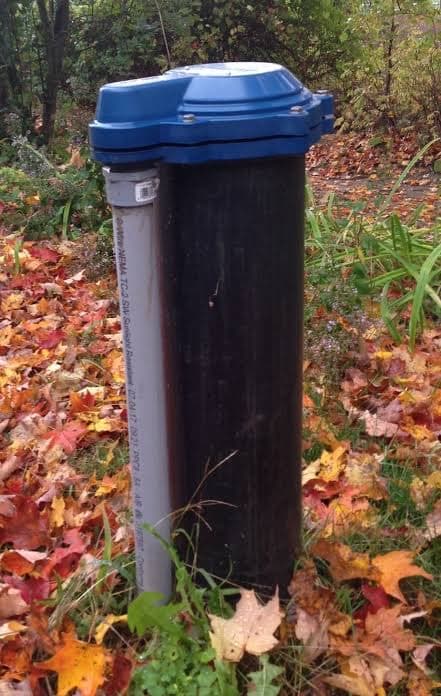
The casing and cap are the barrier between the aquifer and everything happening at the surface. That barrier is the whole reason your water is drinkable.
Short cycling, the thing to listen for
Turn on an outside spigot and listen. A healthy system runs the pump, builds pressure, shuts off, and the tank carries the household for a while before the pump kicks in again. A system that clicks on and off every few seconds is short cycling, and it is doing serious damage.
The usual cause is a pressure tank that has lost its air charge, so there is no cushion left and the pump is doing all the work directly. Every start is hard on a motor. A short cycling well can burn out a submersible pump that would otherwise have run for fifteen more years, and pulling a pump out of a deep well is not a cheap afternoon.
We run water at several fixtures at once and watch what the system does. It is one of the fastest useful tests on a rural property.
Where the well sits matters as much as what it does
This is the part people skip, and it is the part two of us are licensed to think about. Bobby holds a Class 1 Wastewater License and JD holds a Class 3, so on a property with both a well and a septic system we are looking at the whole picture rather than two unrelated boxes.
Things we walk the lot for:
- Distance from the septic tank and field lines. Arkansas sets minimum separation distances for good reason. A well drawing from too close to a drain field is a problem you cannot filter your way out of.
- Grade around the casing. The ground should fall away from the well. A casing sitting in a low spot that ponds after rain is a direct path for surface water.
- Cap condition. Sealed, vermin proof, and above grade. A cracked or missing cap is the single most common reason a bacteria test comes back positive.
- Abandoned wells on the property. Older acreage often has an original well that was never properly plugged. An open abandoned well is both a contamination route and a genuine safety hazard.
- What is uphill. Livestock pens, fuel tanks, equipment parking, and the neighbour's field all drain somewhere.
Freezing, the January problem
Central Arkansas gets cold snaps that are short but sharp, and a rural water system has far more exposed pipe than a house in town. We look at the run from the well to the house, at any wellhouse and whether it has heat, at the pressure tank if it sits in an unconditioned space, and at hose bibs and their shutoffs. A vacant property that was never winterised properly is a particular risk, and plenty of rural listings sit empty for months.
Water quality still belongs on the list
Testing is a separate lab service and it should be ordered as soon as you are under contract, because labs need a few days and some require the sample to reach them within a set window. Start with total coliform and E. coli, add nitrate, and add arsenic and metals depending on the area and what the seller can tell you. If there is treatment equipment in the utility room, ask why it went in.
The Arkansas Department of Health publishes guidance for private well owners and there are certified labs across the state. We will point you at one.
Paperwork worth chasing
Ask for the well log, which records depth, construction, and yield. Ask when the pump was last replaced and by whom. Ask about the recovery rate in late summer, because a well that keeps up in March and struggles in August is a real thing here. If the well is shared with a neighbour, ask for the agreement in writing and find out who pays when the pump fails.
FAQ
Is the well part of a standard home inspection?
The visible equipment, the pressure behaviour, and the placement are. The lab testing and anything requiring the pump to be pulled are separate services.
How long should a well pump last?
Often well over a decade, sometimes much longer. The thing that shortens that life dramatically is short cycling, which is why we listen for it.
The seller says there has never been a problem. Is that useful?
Somewhat. It is worth more when it comes with a well log, a pump replacement receipt, and a recent water test. On its own it is a memory.
Do you inspect rural properties out past the city limits?
Yes. We cover all of Central Arkansas including Perry, Grant, White, and Lonoke counties, and we schedule extra time for acreage with a well, a septic system, and outbuildings.
Related Reading
- Septic Inspection in Rural Central Arkansas: What a Licensed Eye Catches
- Spanish Speaking Home Inspection in Central Arkansas: Buying With Confidence
Book an Inspection
Buying acreage in Central Arkansas usually means a well, a septic system, and a few outbuildings, and all of that takes longer to walk than a house in town. Tell us what you are buying and we will schedule the time for it.
Call A-Team Home Inspectors at (501) 249-4481 or email ATeamHomeInspectors@gmail.com. We inspect across all of Central Arkansas, and se habla espanol.